
Restoring Wetlands to Help Fish Populations Recover
As Earth Day highlights the importance of protecting ecosystems around the world, research from ARCS Scholar Alum Anthony Donahue continues to shed light on how restoring natural habitats can support struggling wildlife populations.
Donahue recently completed his master’s degree in Marine and Estuarine Sciences at San Francisco State University’s Estuary & Ocean Science Center. His graduate research examined how tidal wetland restoration in the San Francisco Estuary affects fish populations and the broader food web.
Fish populations in the estuary, particularly the Longfin smelt, have been declining for decades. Scientists believe much of that decline is linked to the loss of tidal wetlands, which serve as critical nursery habitats for young fish.
Donahue’s research focused on what larval fish eat and what those diets reveal about the health of the ecosystem.
“My thesis research looked at larval fish diets as indicators of food web dynamics in tidal wetland restoration,” Donahue explained.
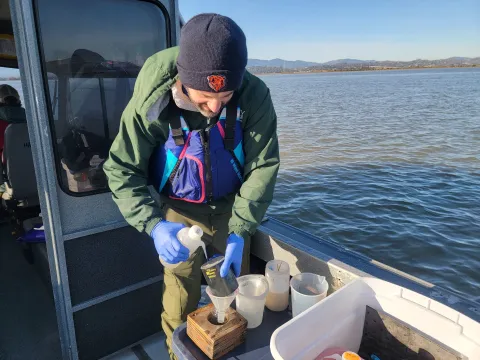
Larval fish are extremely small, often only three to ten millimeters long, about the size of an eyelash. To study them, Donahue collected samples of fish and zooplankton from wetlands at different stages of restoration in the upper San Francisco Estuary. He then dissected the fish under a microscope and used DNA sequencing to identify what they had eaten.
“It’s difficult to visually identify what they’ve eaten because most of the material in the digestive tract is already digested,” he said. “Sequencing the DNA allowed us to figure out exactly what they’re eating.”
By identifying the zooplankton species that larval fish rely on for food, Donahue hoped to determine whether restored wetlands were successfully recreating the type of ecosystem needed to support fish populations.
This type of research is particularly valuable because many wetland restoration studies focus on plants, adult fish, or organisms living on the seafloor. Far less research examines what is happening in the water column, where larval fish and zooplankton interact.
“We wanted to understand whether wetlands were recreating an ideal ecosystem for larval fish and their prey,” Donahue said.
Ultimately, the research aimed to help restoration managers better understand which wetland characteristics support healthy ecosystems and how those insights could help declining species like the Longfin smelt recover.
Donahue’s interest in the work grew from his background studying marine biology and his experience working with endangered fish species in California.
“I’ve worked with species like Delta smelt and Longfin smelt before, so continuing research that focuses on fish conservation was really important to me,” he said.
ARCS played a key role in helping him complete his research.
“It was extremely helpful,” Donahue said. “The grant that supported my research had run out, so the ARCS support helped cover the costs of commuting and continuing my studies.”
As Earth Day reminds us, research like Donahue’s plays an important role in understanding how ecosystems function and how restoring them can help protect wildlife for generations to come.
- Log in to post comments