
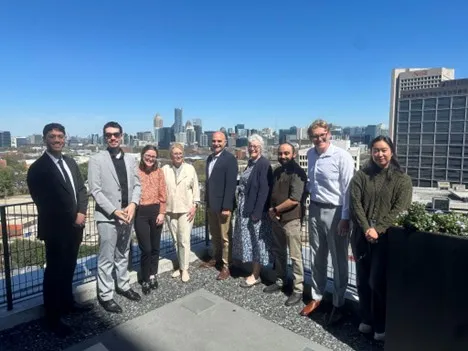
ARCS Scholars represent Georgia to the Congressional Commission
Georgia Life Sciences recently hosted commissioners and staff from the National Security Commission on Emerging Biotechnology (NSCEB) across several sites in Georgia as part of the Commission’s “Biotech Across America Roadshow.” The visit’s goal was for federal leaders to hear directly from industry executives, researchers, students, and state and local partners about the growing biotechnology ecosystem in Georgia.
Congress created the National Security Commission on Emerging Biotechnology (NSCEB) in 2022 and charged it with developing a roadmap to ensure the U.S. remains a leader. In 2025, the group released a report that stated, “If the United States seizes this moment, the future of biotechnology has immense potential.” In its report, the commission called for congressional action to bring the full weight of American innovation to bear on emerging biotechnology innovation and maintain U.S. global leadership.
Two NSCB commissioners, Paul Arcangeli and Dawn Meyerriecks, are traveling the country to assess the U.S.’s current biotech capacity. They visited Georgia to learn about the state’s innovation, policy, and opportunities for biotech. Workforce development initiatives were key recommendations in the NSCEB’s April 2025 action plan for Congress to boost the U.S. biotech industry and strengthen national security.
The Commission’s “Biotech Across America Roadshow” selected Georgia Tech’s Cell Manufacturing Center as part of its Georgia itinerary. Georgia Institute of Technology leads the multidisciplinary NSF (National Science Foundation) Engineering Research Center for Cell Manufacturing Technologies.
Members of the NSCEB commission interacted with Georgia scientists and dignitaries, including ARCS Atlanta Scholars and members, for a tour and conversations.
Six ARCS Scholars from the Atlanta Chapter participated in the NSCEB visit and shared their biotech research with commissioners. Those Scholars are engaged in innovative research using AI, machine learning, and other emerging technologies. The commissioners viewed ARCS participants as “transformative advantages for regional biotech businesses.”
Scholar Nathan Taylor appreciated the opportunity. “Last August, I was very grateful to have been selected for the ARCS Foundation Atlanta Chapter Scholar Award,” he said. “While the generous financial support could not have come at a better time, what I didn’t realize was all the incredible opportunities afforded to Scholars within the ARCS network. It was an amazing experience to meet with the National Security Commission on Emerging Biotechnology (NSCEB) and discuss biotechnology efforts in industry, education, and national security happening in the state of Georgia.”
These ARCS Atlanta Scholars were selected to represent the state of Georgia to the commission, based on their use of emerging technologies in their biotech research.
- Elise Bezold, Emory University
- Sara Kim, Emory University
- Heriberto Nieves, Georgia Institute of Technology
- Neil Patel, University of Georgia
- Nathan Taylor, Georgia Institute of Technology
- Xavier Velez, Georgia Institute of Technology
The commissioners summed up their visit to Georgia: “A skilled workforce is the engine that will drive growth across America’s biotechnology industry, and Atlanta has built multi-faceted training programs that are developing and sustaining the talent pipeline for everything from advanced laboratory research to industrial biomanufacturing.”
View the Commission’s report on the visit to Georgia.
The NSCEB 2025 report lays out practical recommendations that, if adopted, will advance U.S. progress and slow that of our strategic adversaries, particularly China, in the race for biotechnology supremacy.
The Commission’s main recommendation was, “The U.S. government should dedicate a minimum of $15 billion over the next five years to unleash more private capital into our national biotechnology sector. Any smaller amount risks hamstringing U.S. innovation and product development.”
View the NSCEB 2025 report.
More information about the NSF Engineering Research Center for Cell Manufacturing Technologies.
- Log in to post comments