
Unlocking the Hidden Power of Fungi
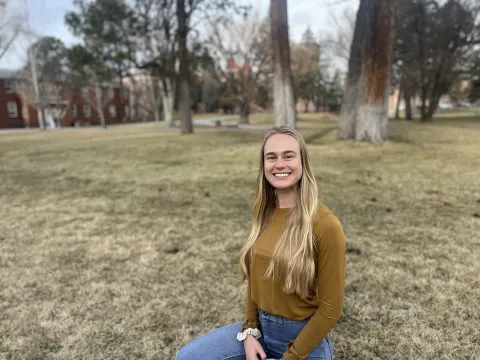
Most people notice plants, trees, and crops growing above ground. Beatrice Bock is focused on what happens beneath the surface.
As a recent graduate from Northern Arizona University with her Ph.D. in Biology, Bock studied the relationships between plants and fungi and how those partnerships can support agriculture, ecosystem restoration, and environmental sustainability.
One of her research projects examined sorghum, an agricultural crop similar to corn. Bock found that plants connected by beneficial fungi were able to share water and grew larger than plants without those fungal connections.
"Hopefully, we can find solutions that work for farmers and for environmentalists," Bock said. "Using microbes instead of relying only on fertilizers could be both more sustainable and better for the environment."
Bock also studied cottonwood trees in the American Southwest, where drought and invasive species threaten important river ecosystems. Her research explores whether fungal partnerships can help these trees survive and support restoration efforts.
In addition to field and greenhouse studies, Bock used machine learning and artificial intelligence to analyze complex ecological data and uncover patterns that might otherwise remain hidden.
Beyond her research, Bock is passionate about mentoring future scientists and recently co-authored a peer-reviewed publication with an undergraduate student she mentored.
ARCS support has helped Bock expand her research network and professional opportunities. Through ARCS Phoenix funding, she was able to organize an international scientific symposium in Canada and attend conferences. Bock has accepted a postdoc with the USDA studying fungal genomes, specifically looking at fungi that interact with crops.
As she continues her work, Bock hopes her research will help farmers, land managers, and scientists better understand the hidden fungal networks that play a critical role in healthy ecosystems.
"Fungi are kind of an unseen but important factor in ecosystems," Bock said. "There's still so much work to be done."
- Log in to post comments