
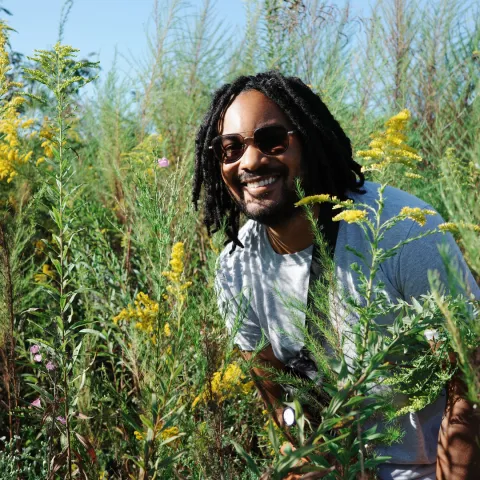
Exploring Nature's Hidden Connections
When most people think of parasites, they imagine something harmful. But for ARCS Atlanta Scholar Jordan Argrett, a Ph.D. candidate in Ecology at the University of Georgia's Odum School of Ecology, parasitic plants tell a much more complex story—one that could reshape how scientists understand ecosystems and conservation.
Argrett studies the relationships between parasitic plants, their host plants, and the underground microbial communities that help ecosystems function. His research focuses on Castilleja, commonly known as the Labrador paintbrush, a partially parasitic wildflower found in the alpine meadows of Colorado.
Unlike most plants, Castilleja not only produces its own energy through photosynthesis but also draws water and nutrients from neighboring plants. Argrett is investigating how these unique interactions influence biodiversity and nutrient cycling throughout an ecosystem.
One way Argrett describes these plants is through the classic story of Robin Hood.
"They connect to dominant plant species and reduce their growth, allowing smaller plants to thrive," he explained. “At the end of the growing season, the parasitic plants return nutrient-rich leaves to the soil, redistributing resources back into the ecosystem.”
His research has now shown that the presence of the parasitic plants themselves increases plant diversity by an average of about three additional species within a community. While the nutrient-rich leaf litter has less influence on the surrounding plant community, it does produce positive changes in the soil's microbial community, highlighting the important role these overlooked plants play both above and below ground.
While the work deepens scientists' understanding of plant ecology, its potential applications reach far beyond the laboratory.
Some parasitic plants produce compounds with anti-inflammatory properties that have been used in medicine. Others may someday help restore damaged landscapes or even assist with environmental cleanup by concentrating pollutants from contaminated soils. Understanding these natural systems could also lead to more sustainable ways of managing parasitic plants that affect agricultural crops.
Argrett's fascination with parasitic plants began with a simple observation: despite occurring on every continent and representing nearly 5,000 flowering plant species, they remain surprisingly understudied.
"I'm really attracted to things that seem oddly overlooked," he said. "I like finding a new place to ask the simplest questions."
That curiosity continues to drive his research today.
As an ARCS Scholar, Argrett says the support has extended well beyond financial assistance. The award has allowed him to build financial stability while fully investing in both his research and his creative pursuits.
"ARCS Foundation has allowed me to not have to be in financial strain while pursuing my graduate studies," he said. "It's also encouraging to know there are people who believe in my work, support my interests, and want me to share them with the world."
For Argrett, that encouragement is just as meaningful as the funding itself. By supporting Scholars who ask overlooked questions, ARCS Foundation continues to advance discoveries that help us better understand the natural world.
- Log in to post comments