
Preparing for the Next Frontier
For ARCS Phoenix Scholar Laura Lee, preparing for the future of space exploration means thinking about everything from the cameras traveling to Mars to the food astronauts may one day grow there.
Lee, a Ph.D. candidate in Astronomy and Planetary Science at Northern Arizona University, focuses her research on preparing for future planetary missions through three distinct projects.
Her first project has already made its way into space.
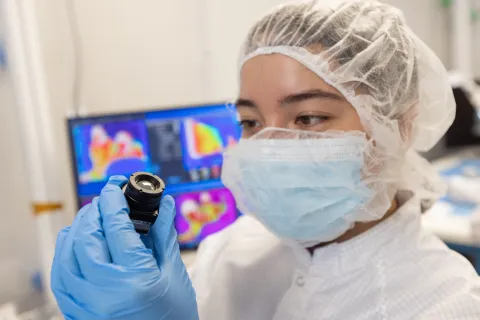
Lee serves as the instrument scientist for the VISIONS cameras aboard NASA's ESCAPADE mission to Mars. Developed at Northern Arizona University, the cameras use commercial off-the-shelf imaging technology adapted for space. Lee has been involved from design and development through assembly, testing, and data collection.
"It's really exciting to be able to be a part of the early stages of instrument development and then finally seeing it working and operational in space," she said.
The project could also help lower the barrier to developing future space instruments by demonstrating that less expensive commercial technology can be successfully adapted for use beyond Earth.
Lee's second project looks toward the asteroid belt. Using the Lowell Discovery Telescope, she collects observations of seven asteroids targeted by an upcoming United Arab Emirates mission, studying their surface composition and looking for signs of water-bearing minerals and metals. The research could help scientists better interpret ground-based observations and inform future planetary missions.
Her third project tackles another challenge of space exploration: growing food.
Lee conducts crop-growth experiments using soils with mineral compositions similar to those found on the Moon and Mars. She is studying whether microscopic fungi can help plants access nutrients in these harsh environments and has begun exploring renewable fertilizers, including processed human waste.
The work could eventually support sustainable, long-term crewed missions while also contributing to research on food production in difficult growing environments on Earth.
As Lee enters the final year of her Ph.D. program, ARCS Foundation support is helping her publish her research, explore career opportunities, and strengthen her skills as a science communicator.
"It's super exciting to be in a room full of people who are inspired by and supportive of the development of science," she said.
That support has also strengthened Lee's confidence in her work. In spring 2026, she put her communication skills to the test and earned first place in Northern Arizona University's three-minute research presentation competition.
After graduating, Lee hopes to work for NASA on planetary missions or explore opportunities in the growing commercial space industry. She also wants to inspire young people who may not realize careers like hers are possible.
"When I was younger, I didn't even know this career was an option," Lee said. "I just really want to help benefit the future of humanity and set them up for success."
- Log in to post comments