
Rooted in Resilience: ARCS Scholar Kauanoe Greene Studies the Future of Hawaiʻi’s Native Plants
As climate change brings rising sea levels and intensifying droughts to Hawaiʻi, ARCS Honolulu Scholar Kauanoe Greene is researching how native plants can survive changing environmental conditions.
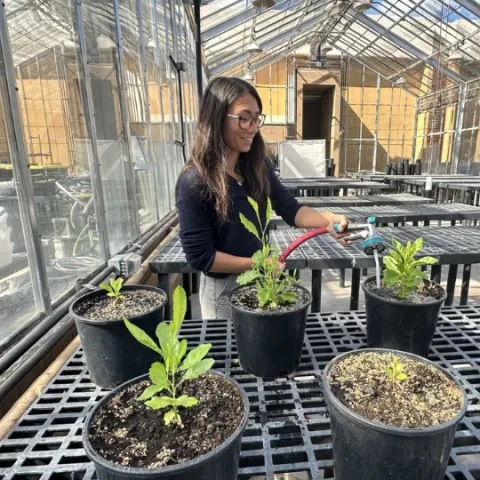
A doctoral student in botany at the University of Hawaiʻi at Mānoa, Greene studies ʻaʻaliʻi, a native Hawaiian plant commonly used in ecological restoration. Her research examines how populations of the species respond to drought, fire and the combined effects of salinity and drought.
“Currently, we're seeing reduced seedling recruitment and establishment because site conditions have been so stressful,” Greene explained.
Her goal is to identify plant populations that can better tolerate these conditions, helping conservation professionals restore Hawaiʻi's native ecosystems.
Greene's ARCS-supported research focuses on how coastal populations of ʻaʻaliʻi respond to increasing salt exposure and drought. By comparing plants from windward and leeward sites across the Hawaiian Islands, she hopes to understand which populations are best equipped to survive these challenges.
The findings could help restoration practitioners select plants suited to specific environmental conditions.
“We're working to identify different populations that may be more tolerant under drought,” Greene said. “Hopefully, they can be outplanted at sites that we predict to become highly arid and saline, in an effort to enhance survivorship and help restore our native ecosystem.”
Support from the ARCS Foundation Honolulu Chapter is helping Greene connect her scientific research with practical conservation efforts.
The funding supports travel between islands to gather seeds and meet with restoration practitioners, whose firsthand knowledge offers valuable perspectives on how native plants grow across Hawaiʻi's diverse environments.
“The funding supports me in connecting with experts from these communities to learn about their insights and knowledge of the area,” Greene shared. "It also helps me purchase greenhouse supplies and materials needed to simulate environmental stressors, grow plants, and monitor their responses under controlled conditions."
Together, these opportunities allow her to combine experimental research with field-based knowledge to better inform restoration efforts.
After completing her PhD, Greene hopes to continue working in conservation or ecological restoration, whether through academic research, teaching, or hands-on fieldwork.
“What is most important to me is contributing to conservation here in Hawaiʻi by reciprocating my aloha for our ʻāina,” Greene said.
With support from ARCS Foundation, Greene is developing the knowledge and connections to help protect Hawaiʻi's native plants and ecosystems for future generations.
- Log in to post comments