
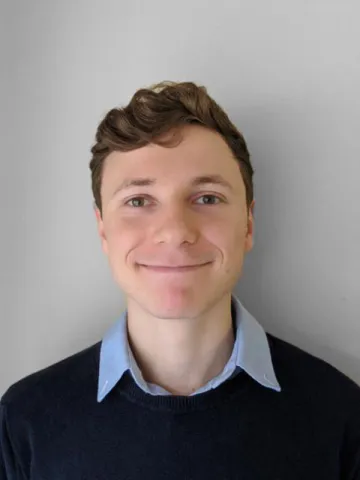
Gene Editing To Improve Blood Transfusions
Benjamin Lesch’s path into science began with a moment of curiosity that never left him. As a middle school student, he first learned about genetic engineering and realized that the building blocks of life could be studied.
“The moment that kick-started my journey into science was in middle school. I remember hearing the term genetic engineering for the first time and learning that scientists could make fish glow green by giving them a gene from a jellyfish,” Lesch says.
That early fascination with biology’s underlying code grew into a clear sense of purpose.
“Right then, I realized that the information for every living thing is written in a universal molecular code, and more importantly, that this code could be rewritten. At that moment, I knew I wanted to be a genetic engineer,” Lesch says.
Today, Lesch is pursuing a PhD at the University of California, San Francisco (UCSF), where his research focuses on making lab-grown blood a reality. Using CRISPR gene editing, he works to identify genetic strategies that address key bottlenecks in transfusion medicine, an area he believes is long overdue for innovation.
“Blood transfusions are incredibly common and critically important, yet the way we supply blood has remained largely unchanged for decades,” Lesch explains.
Recent advances in gene editing have transformed scientists’ ability to study and engineer biology, making it possible to precisely turn genes on or off. Lesch saw transfusion medicine as a field uniquely positioned to benefit from these tools.
“This struck me as a space that hasn’t fully benefited from recent advances in gene editing and is therefore ripe for innovation. Most importantly, it’s a place where I can make a real-world impact,” Lesch says.
Despite being a cornerstone of modern healthcare, the blood supply remains fragile and heavily dependent on donors, with shortages becoming increasingly common. Lab-grown blood offers a promising alternative. While significant scientific challenges remain, progress in gene editing and stem cell biology is bringing that possibility closer to reality.
Looking ahead, Lesch hopes to help translate this work beyond the laboratory and into real-world use.
“My long-term goal is to help make lab-grown blood an option for patients who need transfusions. If the science is successful, I’m very interested in taking this work beyond the lab and into real-world applications,” Lesch says.
As a Northern California ARCS Scholar, Lesch says the support has been both practical and deeply affirming.
“This support shows belief not just in my science, but in me. Because of ARCS, I can fully focus on doing science and working to make the world a better place,” Lesch says.
- Log in to post comments