
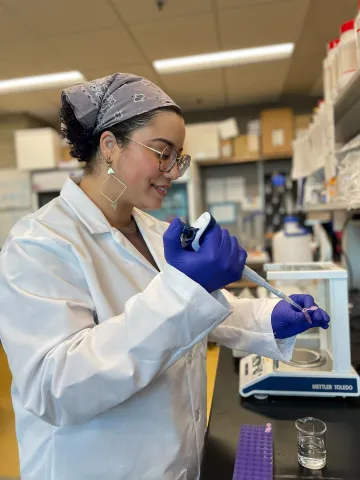
Nicole Quintus Explores New Pathways in Depression Research
For Nicole Quintus, the prevalence of treatment-resistant depression raises an important scientific question: What if there is more to the story?
Quintus, an ARCS Scholar supported by the ARCS Minnesota Chapter, is pursuing her PhD in neuroscience at the University of Minnesota. Her research examines the endogenous opioid system, the natural opioids produced by the body, and how it may be involved in depressive behaviors.
“We have this sort of classic way of thinking of depression and depressive behaviors where it’s related to monoamines, things like dopamine, serotonin, norepinephrine,” Quintus said. “We’ve largely built all of our pharmaceutical treatment models based on that belief.”
But existing treatments do not work for everyone.
“When you still have a large portion of the population that is treatment resistant to those, I think it calls us to look a little bit more closely at the pathway we’re drugging and decide if that really is the entire story or if there’s more to it,” she said.
Quintus conducts preclinical research using an animal model of sustained social stress. Similar to people, she explained, not every subject responds to prolonged stress in the same way. Some remain sociable and interested in pleasure-seeking behaviors, while others exhibit social withdrawal.
“That’s kind of what’s interesting about my model,” Quintus said. “Some animals that go through the same stressor are considered resilient.”
By examining the molecular differences between those responses, Quintus can investigate whether opioid receptors and naturally occurring opioid peptides may play a role in regulating the behaviors. She hopes identifying new pathways could eventually help researchers explore additional approaches to treatment-resistant depression.
ARCS support has also allowed Quintus to take that research beyond her own academic environment. She recently used her Scholar Award to attend an international conference in Montreal.
“It’s given me the ability to attend international conferences, present my work at those conferences and, in turn, get feedback from people outside of my research ecosystem,” she said. “When you get exposure to that, you get exposure to a diversity of opinions.”
Quintus has also found value in the community surrounding ARCS, particularly her connections with women in the Minnesota Chapter who have scientific careers or longstanding ties to science.
They have discussed “how academia was for women in the past versus how it is now,” she said, allowing them to “commiserate on the struggles that still persist and also appreciate what has been overcome.”
“I think that’s very unique,” Quintus said. “You don’t necessarily get that otherwise in academic spaces.”
Quintus expects to complete her PhD in September 2028 and hopes to pursue a postdoctoral fellowship before eventually leading a lab of her own—continuing to ask whether there may be more to the scientific story.
- Log in to post comments